
The European Union is introducing a major update to its Eco-Design framework for external power supplies.
With the adoption of Commission Regulation (EU) 2025/2052, the EU is modernising energy-efficiency and sustainability requirements to reflect today’s rapidly evolving connected device landscape — including the shift toward higher-power USB-C Power Delivery (PD) ecosystems.
For the Connected Consumer Premises Equipment (CPE) industry, this regulation represents more than a compliance adjustment. It marks a fundamental change in how broadband and network devices will be powered, designed, deployed, and supported across the European market.
Why a New Eco-Design Regulation Was Introduced
The previous Eco-Design Regulation for external power supplies, (EU) 2019/1782, established minimum requirements for efficiency and no-load power consumption.
However, the power supply landscape has advanced rapidly since then. Higher-power USB-C PD architectures, greater demand for interoperability, and growing sustainability pressures have exposed key gaps in the regulatory scope.
As a result, Regulation (EU) 2025/2052 has been introduced to address several major objectives:
- Tighter efficiency requirements, particularly at low and partial loads
- USB-C interoperability, supporting the EU’s long-term “common charger” strategy
- Reduced redundancy and e-waste, aligned with circular economy goals
- Stronger contribution to EU climate targets, including the Green Deal and Fit-for-55 framework
Who the Regulation Impacts
The scope of this regulation extends across the entire CPE ecosystem.
It affects:
- Broadband and network equipment manufacturers
- OEMs and ODMs designing CPE hardware
- Power supply vendors and component suppliers
- Operators, MSOs, and service organisations
In practice, any organisation placing powered CPE products onto the EU market will be impacted.
A Shift in How CPE Devices Will Be Powered
One of the most significant outcomes of Regulation (EU) 2025/2052 is that it accelerates the transition away from legacy power architectures, such as fixed-voltage barrel connectors, toward modern USB-C Power Delivery solutions.
The regulation pushes the industry toward:
- Ultra-low standby and no-load power consumption
- High efficiency across the entire load curve
- Detachable cable ecosystems
- Improved interoperability through USB-C PD
- Elimination of outdated external supply designs
Key Engineering Challenges for the CPE Industry
While the regulation supports long-term sustainability, there are several practical design challenges for CPE manufacturers.
Legacy 12V Ecosystems
Most deployed CPE products today are built around 12V DC input, rather than the higher-voltage rails used in USB-C PD systems (15V–20V). Redesigning power stages to support these architectures may require significant engineering investment.
USB-C PD Power Limitations
USB-C PD devices are limited to 3A maximum current without certified e-marker cables.
This means that at 12V, maximum deliverable power is 36W. Any CPE device requiring more than this will need:
- Custom PD power supplies
- Certified e-marker cables
- Careful interoperability validation
Cable and Compliance Complexity
Detachable USB-C cables introduce additional compliance risks.
Replacing supplied cables with low-quality alternatives can create:
- Safety concerns
- Performance degradation including voltage excursions outside specified operating range leading to resets, interrupts and therefore service calls.
- Potential regulatory non-compliance
Manufacturers and operators may need expanded cable qualification and sourcing strategies.
Efficiency at Low and No Load
The regulation places greater focus on reducing wasted energy during standby and low-load operation, requiring improvements in:
- PWM controller performance
- Burst-mode behaviour
- System-wide efficiency optimisation
Operator Challenges: The Hidden Risk in the Field
Beyond design, operators face real-world deployment challenges as USB-C ecosystems expand into broadband infrastructure.
Key concerns include:
Charger Confusion
USB-C chargers and CPE power supplies may appear interchangeable, but they are not.
End users may unintentionally substitute broadband PSUs with phone chargers that are not designed for:
- Always-on network uptime
- Continuous load reliability
- Infrastructure-grade safety margins
Increased Field Failures and Truck Rolls
Detachable cables and “common charger” assumptions increase the likelihood of:
- Incorrect PSU swaps
- Cable mismatches
- Higher customer complaints
- Increased operator service costs and truck rolls
Warranty and Support Complexity
If equipment is powered using non-approved supplies or cables, warranty enforcement and liability may become difficult for both operators and OEMs.
Transition SKU Expansion
During the transition from barrel connectors to USB-C, operators will need to support both legacy and next-generation PSU ecosystems, increasing SKU complexity in the short term.
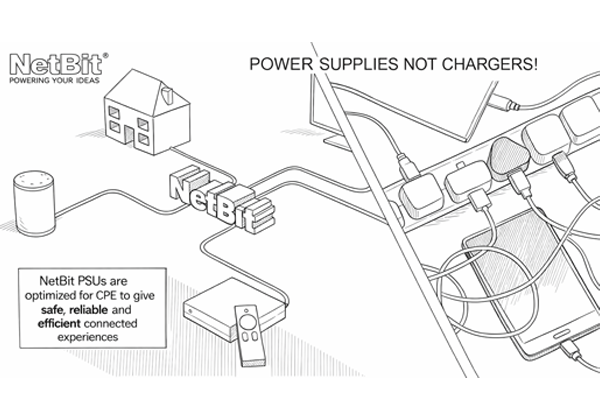
Power Supplies Are Not Chargers
A critical message for the broadband industry is clear:
CPE power supplies are not the same as consumer phone chargers.
Broadband-grade PSUs must deliver:
- Continuous reliability
- Regulatory compliance
- Safe and well specified operation under constant and dynamic loads
- Efficiency optimised for always-connected devices
NetBit power solutions are engineered specifically for CPE environments, ensuring safe, reliable, and efficient connected experiences.
Looking Ahead
Regulation (EU) 2025/2052 represents a major step forward in the EU’s sustainability and energy-efficiency strategy.
For CPE manufacturers and operators, early preparation will be essential — from redesigning power architectures to managing interoperability, cable ecosystems, and service readiness.
NetBit is actively supporting the industry transition with next-generation compliant USB-C PD power supply solutions designed specifically for broadband and connected infrastructure applications.