
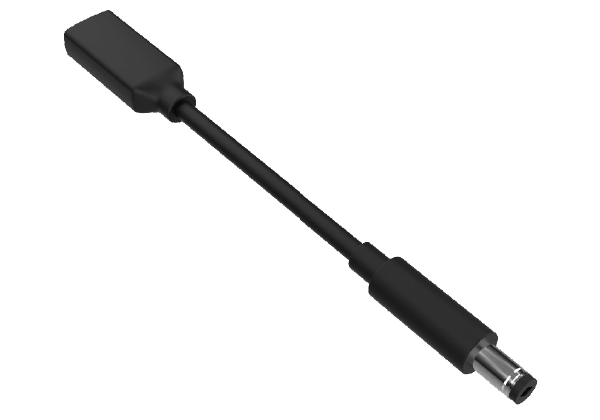
A USB-C to barrel adapter can let compatible Customer Premises Equipment (CPE) retain its existing DC input while moving to a USB-C power supply. For operators and OEMs, this can reduce redesign work and keep suitable platforms in production.
As the EU’s new external power supply requirements approach, this gives product teams a practical option for equipment that will still meet customer needs for several years to come.
What changes in December 2028
Commission Regulation (EU) 2025/2052 introduces new ecodesign requirements for in-scope external power supplies (EPS) placed on the EU market from 14 December 2028.
Unless an exemption applies, AC-to-DC EPS must meet the Common Charger interoperability requirements, including a USB Type-C or USB-PD port and detachable USB-C cabling. The regulation also addresses energy efficiency, output performance, surge resistance and product information.
A compatible CPE platform can retain its barrel input when paired with a suitable, compliant EPS and bridge adapter. A bridge adapter allows compatible barrel-input CPE to operate with a new, compliant USB-C EPS, potentially avoiding redesign of the CPE’s existing DC input. The 2028 application date does not therefore require blanket replacement of CPE already in service.
How the adapter powers existing CPE
A traditional barrel input receives DC power at a specified voltage. It usually has no means of negotiating power with a USB-C source. An active bridge adapter handles USB-C Power Delivery (PD) negotiation on behalf of the device and delivers the specified DC output through the barrel connection.
Consider a 12V, 3A device. Its rated power requirement is 36W. A 45W USB-C supply would need to be utilised in order to offer a 12V mode with sufficient current, supported by the chosen adapter and cable.
12V availability must be verified explicitly. Unlike standard fixed USB-PD voltage levels, 12V may need to be obtained through Adjustable Voltage Supply (AVS). Both the USB-C power supply and bridge adapter must support compatible AVS operation, with sufficient current available at the required voltage. A power supply’s overall wattage rating alone does not guarantee compatibility with the CPE’s power requirements.
Where a bridge makes commercial sense
For an established router or gateway approaching the end of its planned production life, a complete USB-C input redesign may add development cost that is difficult to justify. A bridge can provide a route to continue supplying that platform with a new power solution.
Where compatibility is confirmed, this can preserve the existing input and PCB design, reduce redevelopment work and keep suitable hardware useful for longer. Engineering teams can then focus more of their effort on the next generation of CPE.
The bridge adds a component and an additional connection that must be managed in deployment and replacement processes. For a new platform, building USB-C PD directly into the CPE may be the more appropriate choice.
The NetBit bridge solution
NetBit’s USB-C bridge adapter is designed for compatible legacy DC-input CPE and for use with NetBit NPD30 and NPD45 external power supplies with AVS.
Its specification includes:
- USB Type-C female input connector.
- USB Power Delivery 3.2, including compatible AVS negotiation.
- DC output options of 5V and 12V
- Output current ratings from 1A to 3A.
These limits matter when selecting a migration route. A 12V, 3.5A device exceeds the adapter’s specified 3A current range, even if the USB-C power supply is rated at 45W. That platform needs a different power solution.
At NetBit, we help customers assess their power requirements and expected procurement timeline, then choose the appropriate route for each platform.
The power supply, cable, adapter and CPE should be qualified together. That assessment should cover connector fit and polarity, start-up, continuous and peak loads, voltage at the device, thermal performance and behaviour with unsuitable supplies or cables.
Starting now gives operators and OEMs time to make these decisions, complete validation and prepare their purchasing and service processes before December 2028.
If your roadmap includes barrel-input CPE beyond 2028, share your device’s input voltage, current requirement and procurement timeline with sales@netbit.com. We can help assess whether a USB-C bridge is the right route for your platform.